
Open Outrigger
Built for local organisations. Standards-mapped, expert-anchored and permanently free.
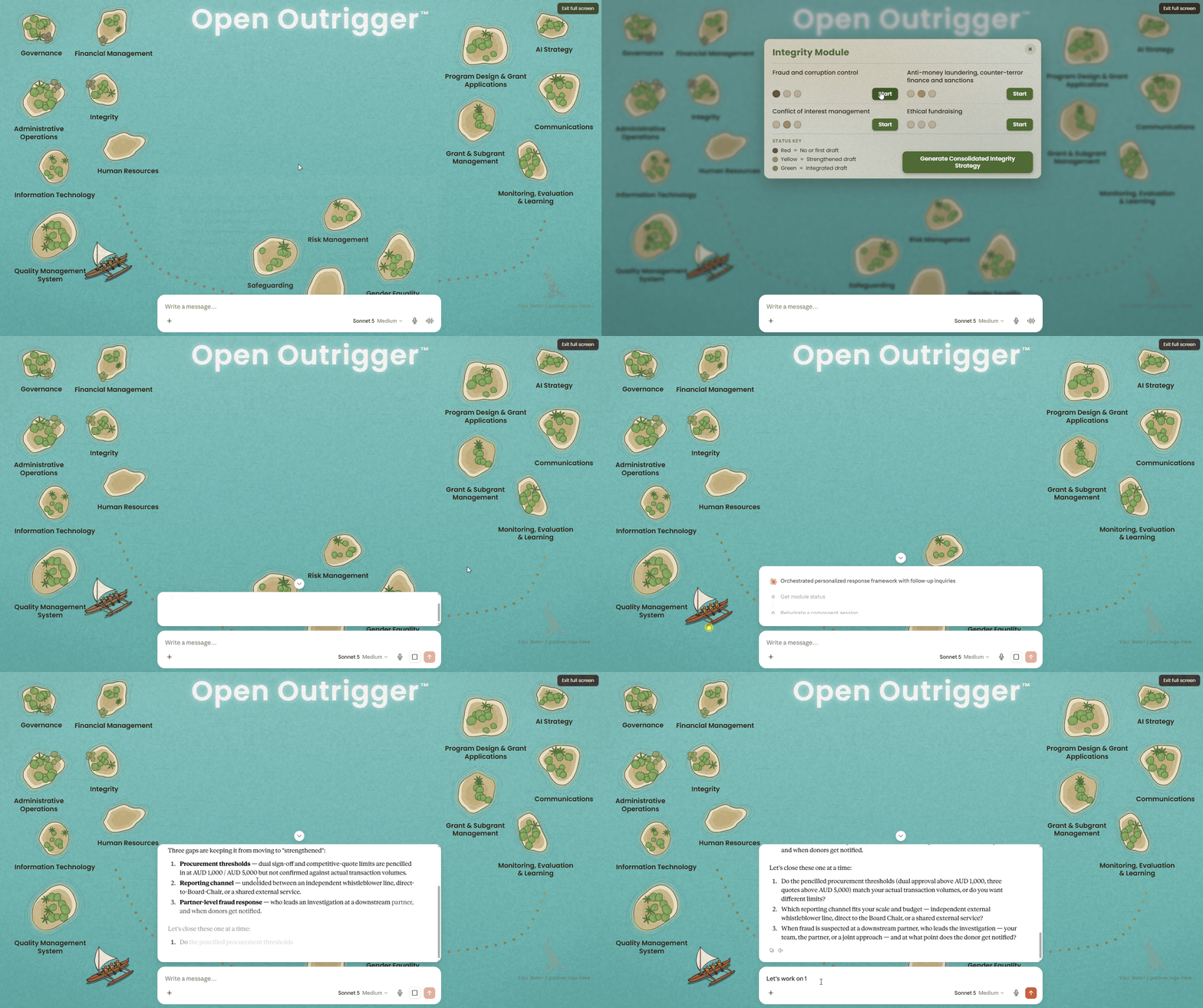
To ensure consistent quality, Open Outrigger is being built in stages. A working demonstrator is being developed hands-on by the founder. Once partners are selected, the platform will move to professional engineering. Priority modules will be validated with experts, then co-designed and field validated with partner organisations across multiple countries.
Modules will be released in phases and beta tested in batches, with higher-stakes content held to additionally strict review before release. How we sequence the modules is set out in our module roadmap.
How will we build it?

How each module will be developed
-
What policies, procedures, frameworks and strategies do organisations need to hold in this domain?
-
What donor and international standards apply and what are the minimum requirements? What is the intent behind these requirements?
-
What problems do organisations commonly face in this domain? What resource requirements (including staff capability) do organisations typically require to meet their obligations?
-
What do the strongest framework examples in this domain have in common?
-
What is common and structural, to be encoded into the module baseline, and what must be tailored to each organisation through structured conversation? Which structured technique governs each tailored conversation? Getting this split right is the crux of module relevance.
-
Every source consulted is licence-checked. We learn from sources and never reproduce restricted material, and we carry transparent attribution of our sources in the publicly accessible module baseline library.
-
Subject matter experts, both international and locally engaged, validate the module baseline and its guiding questions before beta release. High-stakes modules such as child protection carry additional mandatory review gates.
-
Live testing with co-design partners across multiple countries, with further expert review where needed, until modules perform consistently well.
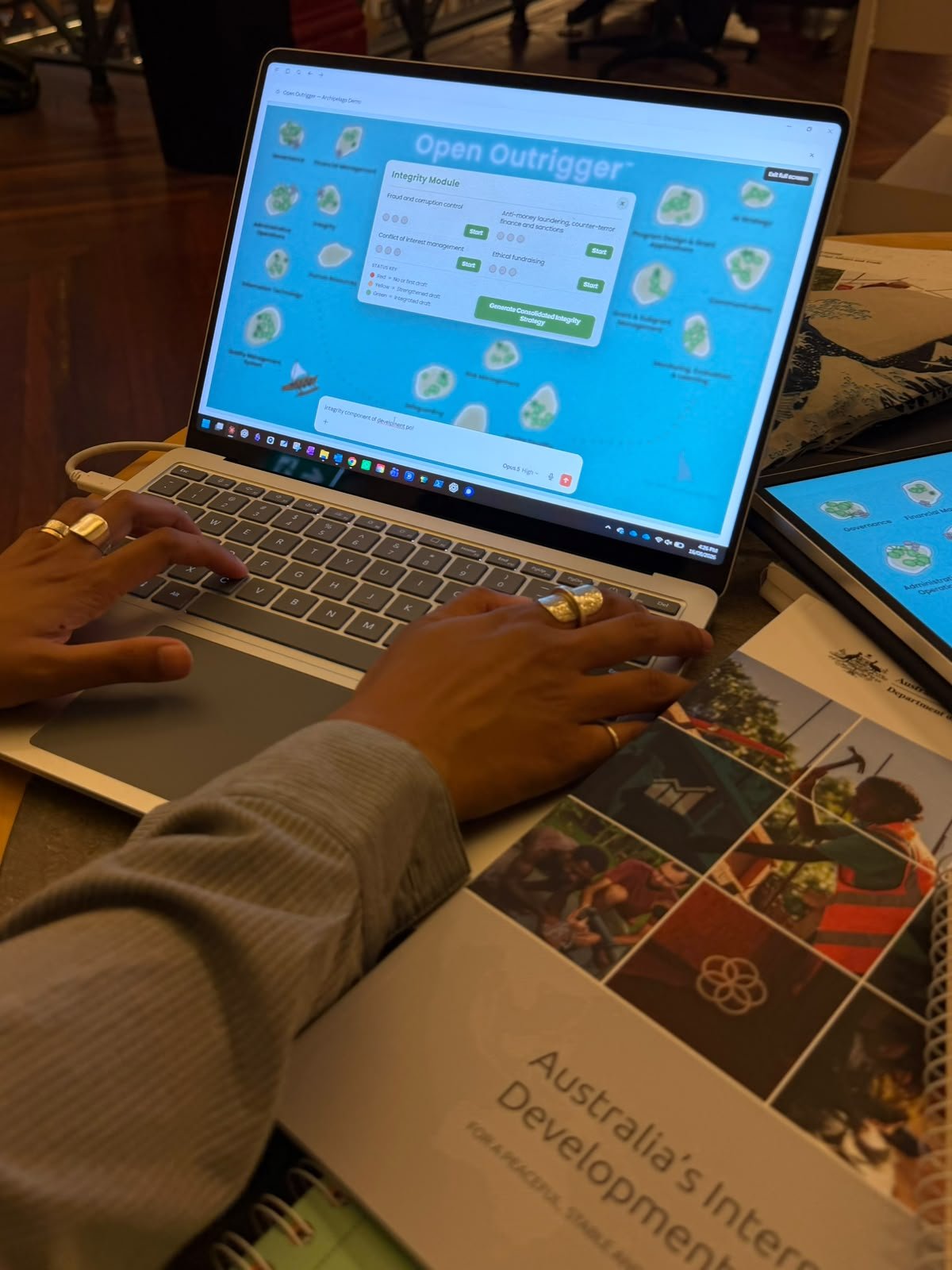
Capability tools risk becoming one-way transfers that impose external frameworks on local organisations. The Outrigger Project addresses this risk through co-design. From the beginning, modules will be co-designed and road-tested with local partner organisations across the Indo-Pacific, including organisations led by women, people with disability and Indigenous Peoples.
Open Outrigger mediates a two-way negotiation between donor standards and local operational realities. The co-design process keeps that negotiation collaborative, and partners will hold visible ownership of what they help build. We will seek co-design partners through the region's own NGO coordination bodies and networks so the work aligns with standards the region has already set for itself. If that could be your organisation, please see our partner details.
Alongside the platform we will grow Outrigger Crew, a community of practice giving regional practitioners standing as co-creators and future leaders of the AI-enabled organisational strengthening practice.
All of this happens in line with our ways of working. A tool built for the region must be built with the region.